
The best rental property renovation is a targeted one. Spend on the rooms tenants judge a listing by (kitchen, bathroom, laundry, flooring, paint, cooling), keep the finish in line with what your tenants pay for, and work out the payback in years before you sign a quote. Done that way, a renovation can lift rent, shorten vacancies and cut maintenance calls. At McArthur Constructions Group we are a licensed Sydney builder, and our team handles demolition, carpentry, plumbing, electrical, waterproofing, tiling and cabinetry as one managed project, with a 7-year workmanship warranty. This guide gives you the numbers and checks to decide what a rental property renovation is worth to you.
TL;DR
- Check the payback first. A $25,000 renovation that adds $100 a week to the rent returns 20.8% a year in gross rent, before finance, vacancy and tax.
- Put money into broad-appeal, mid-spec upgrades: kitchen, bathroom, flooring, paint, cooling. Skip top-end finishes your tenant market will not pay for.
- Tax splits repairs (often deductible in the year) from improvements (claimed slowly at 2.5% a year over 40 years). Your accountant should confirm which your job is.
- In a strata building, kitchen and bathroom work needs owners corporation approval. Occupied homes also come with notice rules for tradespeople.
- Allow for lost rent while the work runs. Two extra vacant weeks on a $600-a-week rental cost $1,200.
Table of Contents
- Why renovate a rental at all
- How to work out the return before you start
- What to renovate first
- What common upgrades cost
- How tax treats rental renovations
- Approvals, strata and tenants in NSW
- Planning the job and the handover
- Renovating your Sydney investment property with us
- FAQ
- Sources
Why renovate a rental at all
The case rests on three things: rent, tenant quality and running costs.
On rent, one agency reports that renovating and refreshing a rental can achieve a 30–50% rise in rental income. Treat that as the top of the range, not a promise. Smaller jobs are documented too. An Australian buyer’s agency describes a repaint and minor kerb-appeal work that let a property be readvertised at $295 a week. It drew three full-price applications and added $2,340 a year, more than double the cost of the work.
On presentation, a property manager’s study cited by Futurerent found that properties with better photos receive 40% more inquiries and 26% more rental income. A finished kitchen or bathroom photographs well, and a good listing is what fills a vacancy quickly.
On running costs, the same source notes the average property needs maintenance of 1–4% of its value each year. New plumbing, waterproofing and fittings mean fewer after-hours calls.
There is also a tenant-side reason. A survey of more than 1,000 renters found half live in homes needing repairs, and 68% fear asking for them could bring a rent rise. A well-fitted property keeps a good tenant for longer, because they have less reason to move.
How to work out the return before you start
Use the same simple test on every job: extra annual rent divided by the cost of the work.
- $25,000 spend, $100 a week extra: $5,200 a year, a 20.8% gross return.
- $50,000 spend on a $700,000 property: at a 4% yield, rent is $28,000 a year. The spend is profitable if it brings in more than $2,000 a year extra. An extra $100 a week is a 10% return, and $200 a week is 20%.
- $5,000 spend, $25 a week extra: $1,300 a year, which takes about 3.8 years to recover through rent alone.
Those are gross figures. Add the costs people forget: loan interest, rates, insurance, strata charges and the cost of finding a tenant. Property advocates also advise comparing genuinely similar, recently leased renovated properties in the same catchment rather than assuming every dollar returns a dollar of rent. Test a schedule that runs several weeks late, not just the fastest one a contractor quotes.
Lost rent matters most when the home is empty during the work. The Woodards example shows two extra vacant weeks on a $600-a-week property cost $1,200. That is why a clear start and finish date is worth as much as a good price.
What to renovate first
Sort every proposed job into one of four groups: safety and compliance, urgent repair, tenant-function improvement or cosmetic. Advisers recommend prioritising water leaks, electrical problems and damaged roofs, and getting a qualified building inspection before you set a budget. Fix those first, because they protect everything else you spend.
After that, favour upgrades that appeal to most tenants:
- Kitchen. A functional, clean kitchen matters more than a designer one. Data guides suggest good flooring, clean paint and a functional kitchen as the broad-impact core.
- Bathroom. One analysis puts recovery of cost at 60–80% for both kitchens and main bathrooms, with smaller investments showing higher potential for cost recovery.
- Cooling and storage. A property manager calls air conditioning almost a non-negotiable in the Australian climate. The suggested minimum is a split system in the living room ($1,300–$2,500 installed) plus bedroom ceiling fans. A built-in wardrobe fit-out can cost as little as $1,200.
- Paint, tapware and landscaping. An agent quoted by realestate.com.au says fresh paint, new tapware and landscaping can move a rent from the bottom bracket to the top without a full renovation.
Avoiding overcapitalising
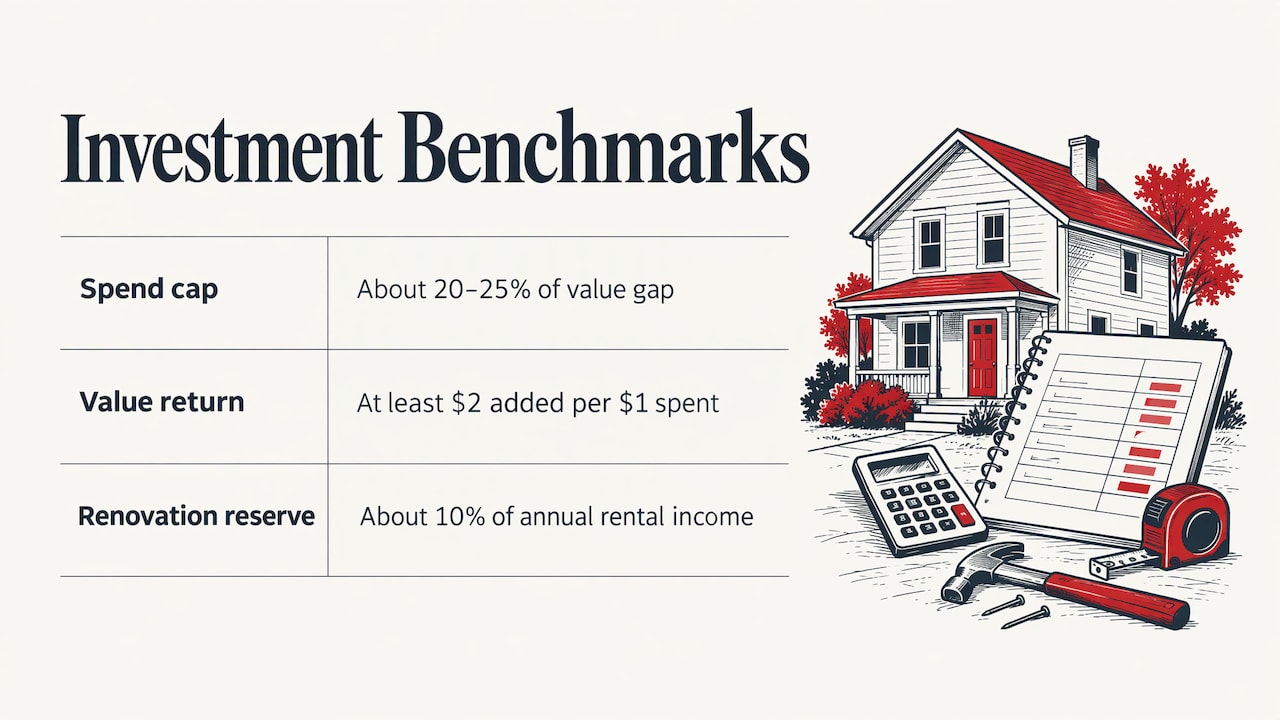
The usual mistake is spending to the owner’s taste, not the tenant’s. A property manager warns against pools, solar panels, marble flooring and high-end kitchens in non-prestige rentals. One example is a $100,000 pool for perhaps $50 a week more rent. A practical test comes from suburb data: look at the gap between what your property is worth now and what a renovated one sells for locally. If planned spend is above about 20–25% of that gap, you need a clear rental and resale case.
Two further rules help. Investors often aim for at least $2 of added value for every $1 spent. Another suggestion is to set aside about 10% of annual rental income for renovations and maintenance. The aim is to match the finish to the tenants you want. A rental in Mosman or Vaucluse supports a very different specification from one in an outer suburb, and your property manager’s local demand data will show where yours sits.
What common upgrades cost
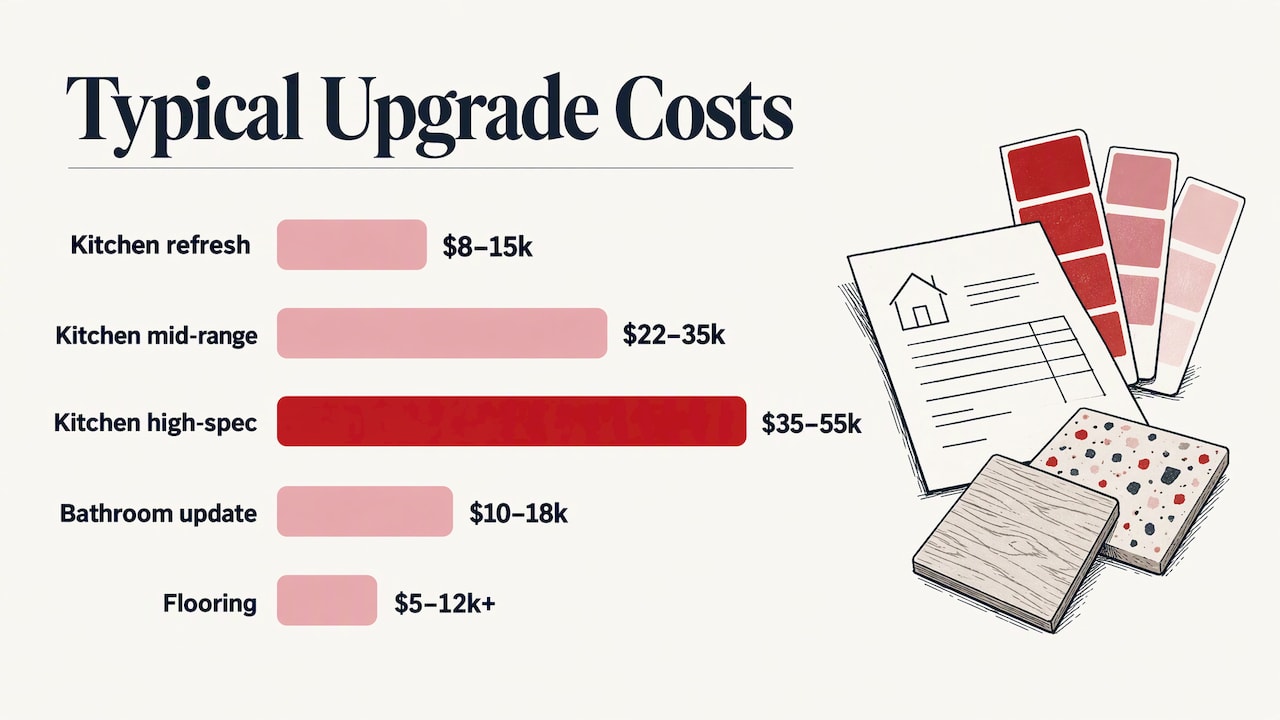
Costs vary with the suburb, access and specification. Inner Sydney sits at the top of national ranges, with labour in Queensland, South Australia and Western Australia 5–15% lower. These published 2026 ranges give you a starting point for budgeting:
| Upgrade | Typical Australian range | Source |
|---|---|---|
| Painting a single room | $400–$1,200 | Your Investment Property Magazine, 2026 |
| Kitchen, cosmetic refresh | $8,000–$15,000 (NSW/VIC metro) | Propfile, 2026 |
| Kitchen, mid-range full replacement | $22,000–$35,000 | Propfile, 2026 |
| Kitchen, higher-spec replacement | $35,000–$55,000 | Propfile, 2026 |
| Typical bathroom update | $10,000–$18,000 | Your Investment Property Magazine, 2026 |
| Flooring | $5,000–$12,000+ | Your Investment Property Magazine, 2026 |
The kitchen figures come with a rent benchmark. Lifting a kitchen from 3–4 out of 10 to 7–8 out of 10 is said to support $60–$150 a week more rent, or $9,360–$23,400 over three years before vacancies and fees. Put your own quote into the return formula above and see where it lands.
Bathrooms and kitchens are also where hidden costs sit: waterproofing, plumbing relocation and electrical upgrades. Ask every builder for an itemised quote that lists inclusions, exclusions, permits and the completion schedule, from a licensed and insured contractor.
How tax treats rental renovations
The tax result depends on what the work is, so classify the job before you start. This is general information only. Confirm your own position with a registered tax agent or accountant.
- Repairs and maintenance. The ATO says these may be deductible in full in the year incurred when they relate to wear and tear or damage from renting out the property, and the property is rented or available for rent. Examples are replacing a broken window or fixing a leaking tap.
- Initial repairs. Fixing defects that existed when you bought the property is capital in nature, not immediately deductible.
- Improvements. Full bathroom or kitchen renovations, a complete roof replacement, first-time air conditioning and complete rewiring are treated as capital improvements. They are deductible at 2.5% a year over 40 years, not at once.
The 2.5% rate applies to construction after 15 September 1987. Eligible renovation work done after that date is claimable by the current owner even if a previous owner paid for it. On the maths, a $400,000 construction cost produces $10,000 a year in capital works deductions. After substantial renovation, a depreciation schedule from a qualified quantity surveyor can capture every eligible item. One industry report suggests renovated properties often see a 15–25% boost in depreciation claims.
Keep itemised invoices that separate repair work from improvement work. It makes your accountant’s job straightforward.
Approvals, strata and tenants in NSW
Strata and council
In a unit, the NSW Government’s strata renovation rules set what you may do. Kitchen or bathroom renovations and changes to walls, floors or ceilings need owners corporation permission. Minor renovations need more than 50% of votes cast in favour. Major work involving waterproofing, structure or common property needs a special resolution with no more than 25% against, and structural changes need 14 days’ written notice. Cosmetic changes that don’t affect structure or waterproofing need no permission.
For houses, purely internal cosmetic work generally needs no council approval. Heritage-listed, flood-affected or non-complying projects can need a development application, and in areas such as Woollahra or Mosman heritage controls are common. Check with your council before you design.
Working around a tenant
When the home is occupied, the NSW Tenant Information Statement sets the entry rules. A landlord must give at least 2 days’ notice to carry out or assess necessary repairs, and 7 days’ written notice for general inspections (maximum four per 12 months). Urgent repairs need no notice. The same statement says a landlord must keep the property in a reasonable state of repair. Tenants are not liable for fair wear and tear, which is why the condition report at the start of the tenancy matters when a property needs refreshing between tenants.
The simplest plan for a major job is to renovate between tenancies and to keep a cash buffer for lost rent. Then you control the access, the noise and the dates. Lining up your trades before the tenant leaves also keeps the empty weeks down.
Planning the job and the handover
A rental renovation runs smoothly when four things are fixed before demolition: scope, approvals, itemised quote and finish date. Agree the order of trades as well. Waterproofing must be done and cured before tiling, and electrical and plumbing rough-in come before cabinetry. When one team manages every trade, there is one schedule to track rather than several.
At handover, the property needs to be ready to photograph and list. Dust from sanding, tiling and demolition lingers in vents and fittings, so plan post-renovation cleaning costs and timing into the final week, ahead of the first inspection.
Our view on renovating a rental
We build and renovate across Sydney’s Eastern Suburbs, Lower North Shore, Northern Beaches and the Hills District, and the investors we work with want the same thing: a property that lets well and stays let. We think that comes from quality in the parts tenants use every day. A bathroom or kitchen is only as good as its waterproofing, plumbing, tiling and joinery, and those are trades that should be coordinated, not scattered.
That is why we put the whole renovation under complete project management: demolition, carpentry, structural alterations, plumbing, electrical, waterproofing, tiling and cabinetry. For a landlord, that means one schedule and one point of contact for the empty weeks, which are the weeks that cost you rent.
We also stand behind the work with a 7-year workmanship warranty. A rental is a long-term asset, and finishes that hold up under years of tenancies protect your return long after the build ends.
McArthur
Renovating your Sydney investment property with us
If you own an investment property in Sydney, our team can take on the bathroom, kitchen, laundry or whole-home work under one managed project. See our bathroom renovations and home renovations pages for what we build. If you want to compare finish levels, our bathroom renovation packages set out Standard, Premium and Diamond options.

When you are ready to scope a job, request a quote with your property address and the rooms you have in mind.
FAQ
Is it worth renovating a rental property?
Usually, when the spend is targeted and the payback is calculated first. Divide the extra annual rent by the cost, then subtract finance, vacancy and tax effects. Mid-spec kitchen, bathroom, flooring and paint upgrades tend to suit the widest range of tenants.
What is considered fair wear and tear in a rental?
The NSW Tenant Information Statement says tenants are not liable for deterioration that occurs over time with normal use and reasonable care. Damage beyond that, such as damage caused by the tenant, is their responsibility and can be claimed against the bond. The condition report from the start of the tenancy is the comparison point.
Can I claim renovation costs on tax?
Repairs for wear and tear from renting can be deductible in the year you pay for them. Improvements such as a full bathroom or kitchen renovation are generally claimed at 2.5% a year over 40 years. Ask your accountant to classify your job before you start.
Do I need approval to renovate a rental unit?
In NSW strata, kitchen and bathroom renovations and changes to walls, floors or ceilings need owners corporation permission. Cosmetic changes that don’t affect structure or waterproofing don’t. Check your by-laws and the NSW Government rules before you book trades.
Sources
- Top renovation tips to increase rental income
- Renters fearful of speaking up about essential repairs
- Could renovating your rental property improve performance
- Should you renovate your investment property
- Rental renovation ROI in Australia 2026 data guide
- From fresh paint to granny flats: ways to increase rental income
- Which renovations deliver the best returns
- What to renovate in your investment property
- Investment property renovation feasibility
- Renovation ROI calculator
- Before you renovate your investment property
- Return on investment for common investment property upgrades
- ATO: Rental properties, repairs, maintenance and capital expenditure
- Rental property tax deductions guide 2026
- What is a tax depreciation schedule
- Which investment property expenses are tax deductible
- How strategic renovations can maximise property value
- NSW Government: Strata renovation rules
- NSW Tenant Information Statement