
A good bathroom renovation in Mosman comes down to three things: a fixed written scope, correct waterproofing, and one licensed team accountable for every trade. Most bathroom problems start in the walls and floor, not on the surface. They show up years later as leaks, lifted tiles and mould. We are McArthur Constructions Group, a licensed Sydney builder, and we handle demolition, plumbing, electrical, waterproofing, tiling and cabinetry under one project manager, with a 7-year workmanship warranty on the work.
This guide covers what Mosman homeowners need to decide before work starts: what pushes the price up, which rules apply in NSW, what happens at each stage, and where renovations go wrong.
TL;DR
- Cost is driven by scope, not just finishes: moving plumbing, changing the layout and repairing hidden water damage move the price far more than a different tile.
- NSW requires a written contract for residential work over $5,000, and larger jobs carry extra requirements including insurance details and a cooling-off period.
- Shower walls must be waterproofed to a minimum height under the National Construction Code, and the membrane needs time to cure before tiling.
- The costliest mistakes are vague quotes, unlicensed trades and rushed waterproofing.
- One builder managing every trade, with a workmanship warranty, keeps the whole job accountable.
Table of Contents
- What a Mosman bathroom renovation involves
- What affects the cost of a bathroom renovation
- NSW rules every Mosman homeowner should know
- The stages of a bathroom renovation
- Mistakes to avoid
- Making the bathroom work for your family and your property
- Perspective: why the builder matters more than the tile
- Choosing a package or a custom bathroom
- FAQ
- Sources
What a Mosman bathroom renovation involves
Mosman has a wide mix of housing: federation and inter-war homes with original bathrooms, 1960s and 1970s apartment blocks, and large modern family houses on the slopes toward the harbour. Each brings different problems. Older homes often have cast-iron or galvanised pipes, timber subfloors and little or no modern waterproofing. Apartments add strata approvals and restricted working hours. Newer homes usually need a refresh rather than a rebuild.
A full renovation means stripping the room back to the frame, correcting what is behind the walls, waterproofing, then rebuilding with new plumbing, electrical, tiling, joinery and fixtures. A cosmetic update that keeps the layout and services can be much quicker. Knowing which of the two you need is the first decision, because it shapes everything that follows.
What affects the cost of a bathroom renovation
No honest builder can give you a reliable figure without seeing the room. Published price ranges across Sydney are wide because the variables are wide. These are the ones that matter most.
Layout changes
Moving a toilet, shower or vanity means relocating drainage and water lines, often cutting into the floor slab or framing. Keeping fixtures where they are is the single biggest saving available. If you are adding a second bathroom or an ensuite as part of a larger project, it is worth planning alongside a home extension so the plumbing is designed once.
Hidden conditions
Old bathrooms often hide rotten subfloor, failed membranes or corroded pipes. You rarely know until demolition. Allow for it in the budget and ask how your builder handles variations: they should be priced and approved in writing before the extra work starts.
Waterproofing and tiling
Waterproofing is not optional and not a place to economise. Tiling cost depends on tile size, pattern, the number of cuts and the area covered. Large-format tiles, mosaics, and full-height wall tiling all take more labour than standard floor and half-height wall tiles.
Fixtures, joinery and finishes
Freestanding baths, wall-hung vanities, custom cabinetry, stone benchtops, underfloor heating and frameless glass all lift the price. Mosman buyers often choose premium finishes, which is a reasonable use of budget when the work behind them is done properly.
Access and site conditions
Steep driveways, limited parking, third-floor apartments and strict strata hours all add time. A good quote reflects the real site, not an average one.
For a broader breakdown, our bathroom renovation cost guide explains how the main costs are built up.
Can it be done for $5,000 or $10,000?
A cosmetic refresh, such as repainting, new tapware, a new vanity top and replacing a mirror, can sit in a small budget. A full strip-out, waterproofing and retile is a different job. The $5,000 mark matters for another reason: NSW law requires a written contract for residential building work over $5,000, including labour and materials. A full renovation will almost always exceed it.
NSW rules every Mosman homeowner should know
Licensing and the written contract
In NSW, residential building work over $5,000 needs a written contract from a licensed builder or tradesperson. The NSW Government guide sets out that jobs from $5,000 to $20,000 count as small and those over $20,000 as large, each with its own contract type. Large-job contracts must include insurance details, progress payments, warranties and a 5-day cooling-off period.
In practice, check three things before signing:
- The builder’s licence number matches the work being done.
- The contract states the full scope, the selected products, exclusions, the programme and the payment schedule.
- Progress payments are tied to completed stages, not dates.
It also helps to have drawings or a detailed scope sheet so the contract has something concrete to refer to. Seeing how a permit drawing service structures a drawing set gives you a sense of the detail worth asking for.
Council approval in Mosman
Mosman Council explains that minor works may be exempt development, meaning council approval is not needed if the project meets set standards. If the criteria cannot be fully met, a complying development certificate or development application is required first. Like-for-like internal bathroom work often falls within the exempt category, but anything that changes the building’s structure, external walls or heritage fabric needs checking. Many Mosman streets sit in heritage conservation areas, so confirm before you assume.
If you live in an apartment, you also need strata approval and must follow the building’s by-laws on working hours, lift use and noise.
Waterproofing and the National Construction Code
Waterproofing is the most regulated part of a bathroom. The NSW Government confirms the current edition is NCC 2022 Amendment 2, in effect from 29 July 2025, with NSW due to adopt NCC 2025 on 1 May 2027. Check the Building Commission page for the edition that applies when your work is lodged.
Under NCC 2022, shower walls must be waterproofed to at least 1,800mm, and walls beside a bath to at least 150mm above the rim. The membrane then needs 24 to 72 hours to cure before tiling, and most states require an inspection at this stage. Plumbing and electrical work must be done by licensed trades who issue certificates of compliance.
Two NSW details are worth knowing:
- Waterproofing is excluded from regulated building work only when it results from bathroom, kitchen, laundry or toilet alterations carried out as exempt development and relating to a single dwelling.
- In multi-unit buildings, the rules are tighter. Construction Legal notes that repairs once treated as like-for-like can now trigger the full design, declaration and lodgment pathway, and a small moisture repair can uncover defects that require a full bathroom replacement.
If you are in an apartment, speak to your strata manager and builder early about which pathway applies. Certifiers cannot issue an occupation certificate until all compliance declarations are lodged on the NSW Planning Portal, so this affects your timeline.
The stages of a bathroom renovation
A full renovation typically runs in this order. Timing varies with size and complexity, so ask for a programme in writing.
- Design and scope. Layout, fixtures, tile selections and the budget are fixed. Anything undecided here becomes a variation later.
- Approvals. Council, certifier or strata approvals are confirmed before demolition starts.
- Demolition and strip-out. Old tiles, fixtures, linings and the existing membrane come out. This is when hidden damage is found.
- Structural and carpentry repairs. Rotten framing or subfloor is replaced, floors are levelled to fall correctly toward the drain, and any wall changes are framed.
- Rough-in plumbing and electrical. Pipes, drainage, wiring, exhaust fans and lighting are positioned while walls are open.
- Waterproofing. The membrane is applied to floors and walls to the required heights and left to cure. This is the stage that gets inspected.
- Tiling. Tiles are laid over the cured membrane, grouted and sealed. Good tiling depends on a flat substrate, which is why stages 4 to 6 matter.
- Cabinetry, glass and fit-off. Vanity, mirrors, screens, tapware, toilet and accessories go in. Plumbing and electrical are connected and certified.
- Final inspection and handover. You check the finished work against the contract, and any defects are listed and fixed.
On a project with many trades, the schedule often slips between stages, not during them. A plumber who is late holds up the waterproofer, who holds up the tiler. Having demolition, carpentry, plumbing, electrical, waterproofing, tiling and cabinetry coordinated by one project manager is how we keep that sequence tight.
Mistakes to avoid
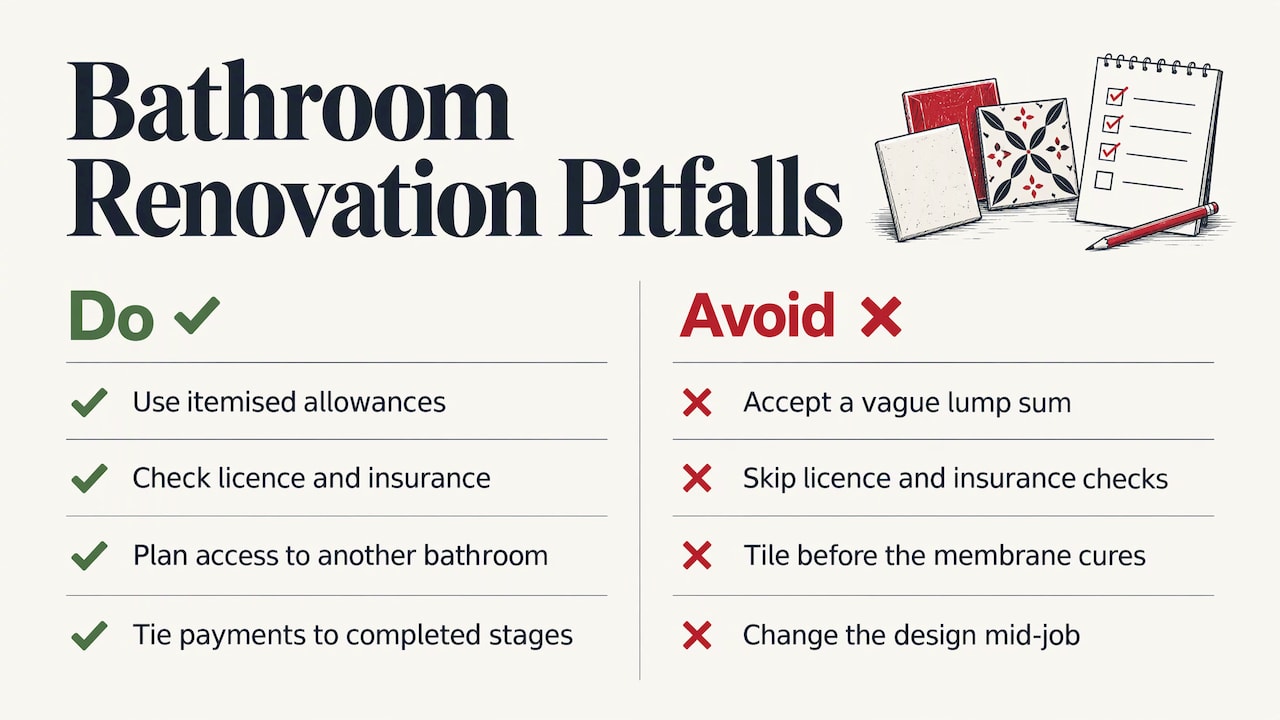
Accepting a vague quote. A lump sum with no inclusions leaves room for disputes. Insist on itemised allowances for tiles, fixtures and tapware, and a clear list of what is excluded.
Not checking the licence and insurance yourself. Look up the builder’s licence on the NSW Government licence check and ask for the insurance certificate. A checklist from The Wombat also recommends confirming permissions from council, the certifier and strata before work starts.
Cutting corners on waterproofing. A membrane that is too low, skipped at corners or tiled over before curing is the classic cause of failure. The repair usually means pulling up the finished bathroom.
Changing the design mid-job. Late changes to tiles, niches or fixtures cost time and money, especially once the membrane is down.
Forgetting household logistics. You may be without your only shower for weeks. Plan access to another bathroom, and ask your builder for a realistic programme. In apartments, book lifts and check noise hours.
Paying too much upfront. Payments should follow progress, as set out in the contract, not run ahead of the work.
Underestimating the ordering lead time. Imported tiles, custom vanities and glass can take weeks to arrive. Order early so the programme does not stall.
Making the bathroom work for your family and your property
Families need durable, easy-to-clean surfaces, non-slip floor tiles, enough storage and a layout that works for several people in the morning. Sensible choices include a wide shower with a fixed screen, a vanity with deep drawers, good ventilation and floor tiles with a slip-resistant finish. If young children or older relatives use the room, hobless showers and wall reinforcement for future grab rails are cheap to include during the build and expensive to add later.
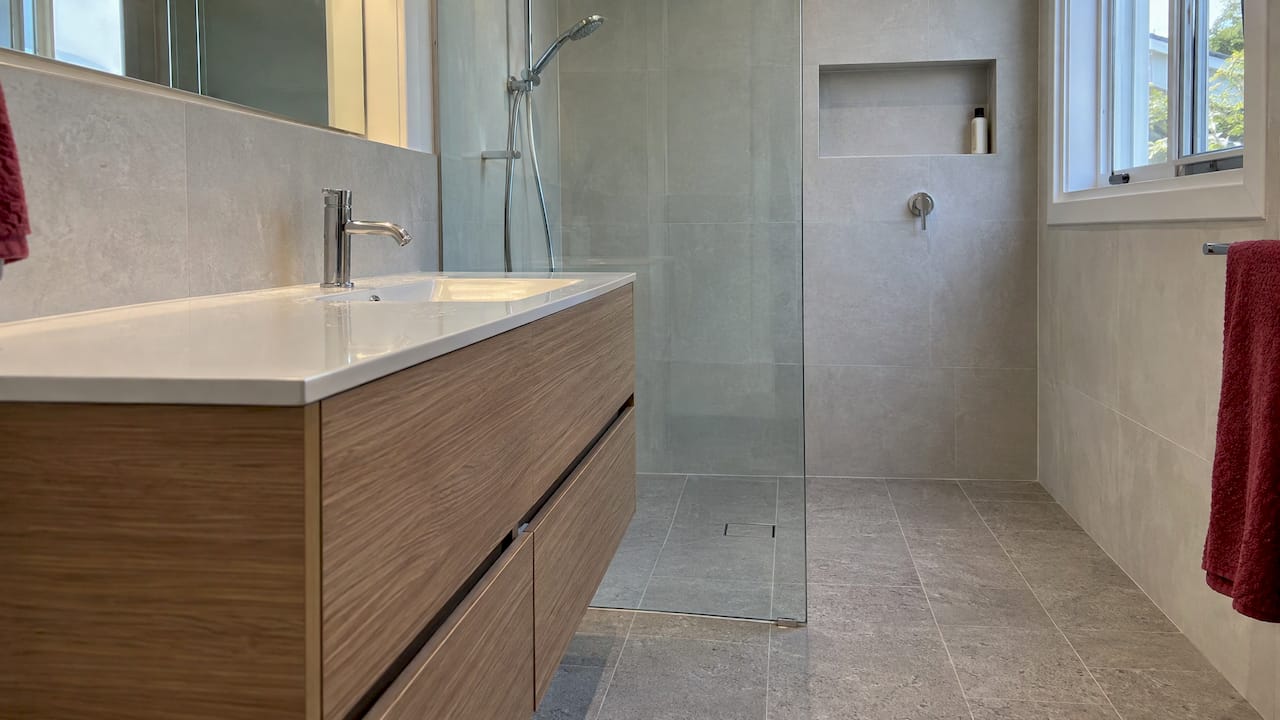
For property owners and investors, a well-built bathroom is one of the rooms buyers and tenants judge first. Clean lines, quality waterproofing, and timeless tiles tend to age better than trend-driven choices. If a bathroom is part of a wider upgrade, our home renovation work can include the kitchen, laundry and living areas under one contract.
Perspective: why the builder matters more than the tile
We have built our bathroom work around one idea: the finished surface is the last 10 per cent of the job. The other 90 per cent is the frame, the falls, the drainage, the membrane and the sequence in which licensed trades arrive.
That is why we run bathrooms as complete projects, not as a set of separate trades. Demolition, carpentry, structural alterations, plumbing, electrical, waterproofing, tiling and cabinetry sit under one project manager, so there is one person accountable if something does not line up.
For Mosman homes, where an older house or a strata building brings its own constraints, that accountability matters. We back the work with a 7-year workmanship warranty, because a bathroom should be judged by how it performs years after handover, not on the day the scaffolding of trades leaves.
McArthur
Choosing a package or a custom bathroom
If you want a clear starting point, we offer three bathroom packages: Standard, Premium and Diamond. They suit homeowners who want a defined level of finish without designing everything from scratch. If your bathroom needs something more tailored, such as a layout change, bespoke cabinetry or a luxury specification, we scope it as a custom project.
Our bathroom renovation packages page shows the three tiers. For custom work, see our Sydney bathroom renovations service, and for a fixed scope and price for your own bathroom you can request a quote.
If you want to see the finished standard before you decide, our project gallery shows recent work.

We work across Sydney’s Eastern Suburbs, Lower and Upper North Shore, Northern Beaches and the Hills District, including Mosman, Cremorne, Neutral Bay and Northbridge.
FAQ
Do I need council approval to renovate a bathroom in Mosman?
Often not, if the work is minor and meets the exempt development standards, but changes to structure, external walls or heritage items usually do. Mosman Council’s development application guide explains the exempt and complying pathways. Apartment owners also need strata approval, and your builder should confirm the pathway before demolition.
What is the most expensive part of a bathroom renovation?
Usually the labour-intensive parts: moving plumbing and drainage, repairing hidden water damage, waterproofing and tiling. Premium fixtures, custom joinery and glass add to the total too. Keeping the existing layout is the most effective way to control the budget.
How long does a bathroom renovation take?
A full strip-out and rebuild runs through several stages, and the waterproofing membrane alone needs 24 to 72 hours to cure before tiling. Total time depends on size, approvals and how long custom items take to arrive. Ask your builder for a written programme before you sign.
What are the most common mistakes?
Vague quotes, unlicensed trades, rushed waterproofing and late design changes cause most problems. Fix the scope in writing, confirm the licence and insurance, and have the membrane inspected before tiling begins.
Is a written contract really required?
Yes. In NSW, residential building work over $5,000, including labour and materials, needs a written contract. Larger jobs must include insurance details, progress payments, warranties and a 5-day cooling-off period.
Sources
- NSW Government: Guide to providing home building contracts
- Mosman Council: Development Application Guide
- NSW Government: How to comply with the National Construction Code
- NSW Government: Certifier obligations when working on regulated buildings
- Design and Building Practitioners Regulation 2021 (NSW), reg 13
- MyHomeware: Bathroom Renovation Checklist
- Construction Legal: Compliance for remedial building work in NSW

2 Responses